



If you've been waiting for the Minnesota housing market to finally feel a little more normal, you're starting to see it.
More homes are coming onto the market. Buyers have more choices. Sellers are having to be a little more thoughtful about pricing. And yet, homes are still selling and prices are still moving higher.
That's the story coming out of the June housing numbers.
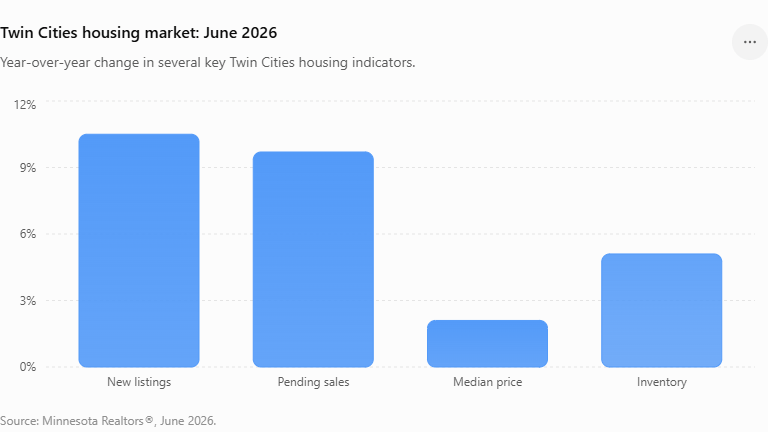
According to Minnesota Realtors, the number of homes for sale across the state reached 19,008 in June, up 7.5% from a year ago. In the Twin Cities, inventory increased 5.1% to 10,897 homes. At the same time, pending sales increased 8.0% statewide and 9.7% across the metro.
That's an important combination.
We're not seeing demand disappear. We're seeing more supply meet buyers who are still willing to buy.
More Inventory Doesn't Mean Prices Are Falling
This is probably the biggest misconception I hear when people see inventory increasing.
More homes for sale does not automatically mean prices are going down.
In June, the median sale price in Minnesota was $375,000, up 1.4% from last year. In the Twin Cities, the median increased 2.1% to $410,000.
So while inventory is improving, homeowners aren't suddenly watching their equity disappear.
What's changing is the rate of appreciation and the amount of competition between buyers.
That's a big difference.
During the hottest years of the market, buyers often had to make quick decisions, compete against multiple offers, and sometimes give up contingencies simply to get a house.
Today's market is giving buyers a little more breathing room.
That doesn't mean every house is negotiable.
It means the right house still gets attention, but buyers have more choices when a house isn't priced or presented correctly.
The Twin Cities Are Still Moving
Another encouraging sign is that buyers are actually doing something.
Pending sales in the Twin Cities were up 9.7% from a year ago in June, while new listings increased 10.5%.
That tells us something important.
People aren't necessarily sitting around waiting for mortgage rates to return to 3%.
They're adapting.
Some buyers have decided that waiting indefinitely doesn't make sense. Others are finding that additional inventory gives them a better chance of finding the right home without the same level of competition we've seen in previous years.
And sellers are responding too.
More homeowners are choosing to list, which is helping relieve some of the supply constraints that have been a defining feature of the Minnesota market.
Minneapolis Is Seeing an Even Bigger Increase in Inventory
The national Homes.com report adds another interesting piece to the story.
Homes.com reported that Minneapolis inventory increased 16.2% year over year in June, compared with a 4.2% increase nationally. Its Minneapolis data also showed a median sale price of $410,000, up 2.0% from a year ago.
That's a substantial increase in available homes.
But it needs some context.
Homes.com's Minneapolis market numbers and Minnesota Realtors' Twin Cities metro numbers are measuring different geographic areas and using different datasets, so I wouldn't mix the two numbers together as though they're measuring the exact same market.
What they do agree on is the bigger trend:
More inventory is reaching Minnesota buyers.
And that's good for the market.
Sellers Still Have an Advantage
Even with more inventory, I wouldn't describe the Twin Cities as a buyer's market.
Minnesota Realtors reported just 2.8 months of supply in the Twin Cities in June. That's more balanced than we've seen recently, but it is still below what would traditionally be considered a fully balanced market.
Homes were also selling for an average of 99.6% of the asking price in the metro.
So sellers aren't exactly being pushed to the sidelines.
What has changed is the margin for error.
A home that is priced correctly, shows well, and is marketed properly can still attract buyers quickly.
A home that is overpriced or needs significant work may have a much different experience.
That's why I think pricing strategy matters more today than simply asking, "How's the market?"
Buyers Have More Options, But That Doesn't Mean They Should Wait
For buyers, I think the current market presents an interesting opportunity.
You have more inventory than you did a year ago, more time to evaluate properties, and potentially more room to negotiate.
But I wouldn't build a buying strategy around waiting for prices to crash.
The June numbers don't support that story.
Prices are still increasing, sales activity is improving, and demand is still there.
Instead, I'd focus on finding the right property and making sure the numbers make sense for your situation.
If the right home comes along at the right price, today's market gives you more opportunity to negotiate than buyers had during the frenzy of a few years ago.
That's a pretty good position to be in.
So, What Does This Mean?
If I had to summarize the Minnesota housing market in one sentence, I'd say this:
We're moving from a market driven by urgency to one driven more by strategy.
Buyers have more choices. Sellers still have demand. Prices are holding. Inventory is improving. And the number of people actually buying and selling is increasing. That's not a market that's broken. It's a market that's beginning to function more normally.
Of course, the statewide and Twin Cities numbers are only the starting point. Real estate is incredibly local, and the experience of a buyer or seller in Eagan can be very different from someone in Minneapolis, Lakeville, Edina, Rosemount, or Burnsville.
That's why I pay much more attention to what is happening at the neighborhood and price-point level than to a single national headline.
The national market report is useful for understanding the big picture. But when you're deciding whether to buy or sell a home, your local numbers are the ones that matter.
Sources: Minnesota Realtors June 2026 Housing Market Report and Homes.com National Housing Market Report.
Check out this article next